How to Choose MEV Protection or a Private Route Before a Crypto Swap

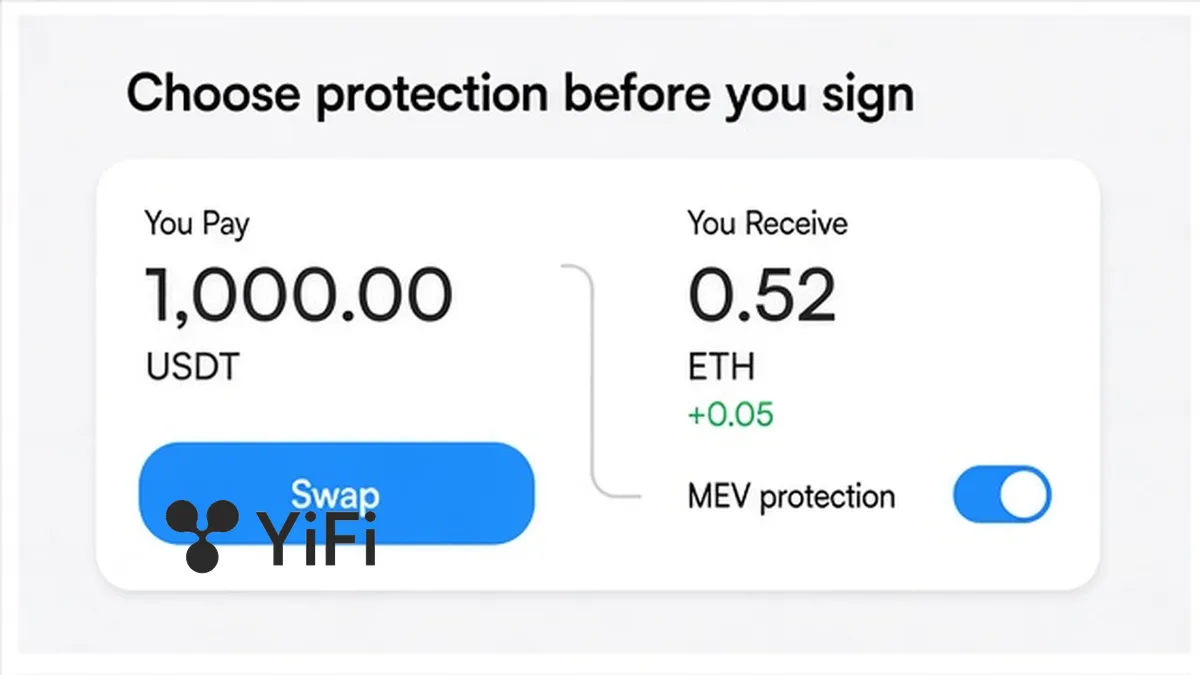
A pending swap on a public mempool is like shouting your trade in a crowded room: bots can hear the size and path, then sandwich you for a worse fill. Before you sign, score size vs pool depth, multi-hop risk, and whether the chain has a gossip mempool. Then name one layer – private/MEV submission, a veiled aggregator route, or a Private/Stealth rail – or keep the public path with a one-line reason, and re-check min received plus destination.
Summary: MEV protection and a “private route” are not one switch. Score sandwich risk first, then choose private submission, a veiled Smart Routing path, a Private/Stealth rail, or a plain public path. Enable protection only with a named reason, keep a sane min received, and never rebroadcast a protected swap onto the public mempool to speed it up.
MEV (maximal extractable value) is extra profit someone takes by reordering or inserting trades around yours. A sandwich is the common pattern: a bot buys ahead of you, lets your swap move the price, then sells into that move. The public mempool is the open waiting room for pending txs; a private route keeps your pending trade off that gossip feed. This is a pre-sign checklist – not a full MEV essay and not a slippage or DEX vs CEX tutorial.
How to score the trade: size, pool depth, multi-hop path, and public-mempool sandwich risk
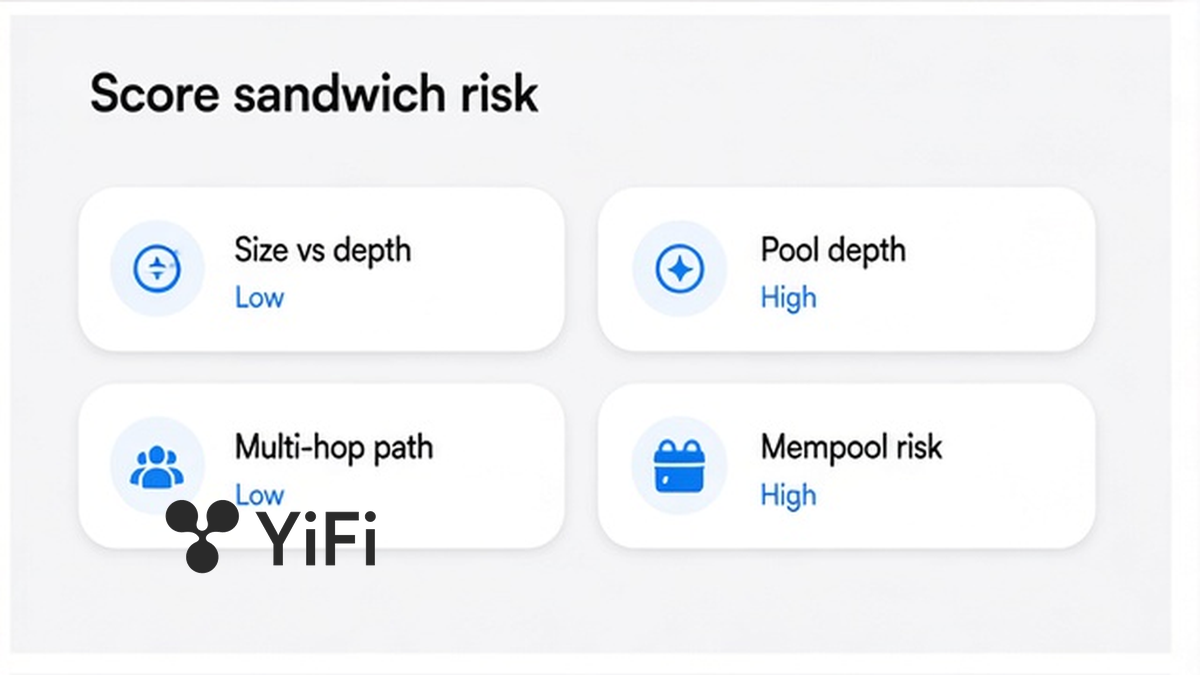
Do score the trade before any toggle. Ask four questions: Is size large relative to the pool? Is liquidity thin or the pair volatile? Does the quote hop through several AMM pools? Does this chain expose pending swaps in a public mempool, or does a sequencer already limit third-party sandwiches (common on some L2s)?
GetBlock: protect value-moving txs such as DEX swaps; plain transfers often need less. OKX DEX docs (an industry analog, not a YiFi rule) recommend protection for large or time-sensitive trades; optional for small tests. BTR notes that on Base and many L2s a sequencer limits classic public-mempool sandwiches – so “always on” is wrong. If sandwich payoff looks low – small size, deep pool, single hop, sequenced L2 – keep the public path. If size is material vs depth, the pair is thin, or the path is multi-hop on a gossip mempool chain, plan protection.
Do: Write one risk sentence (“large vs ETH pool on mainnet, multi-hop”). Don’t: Flip every MEV switch by habit on a tiny liquid L2 swap.
How to separate MEV protection from slippage, price impact, and quote freshness
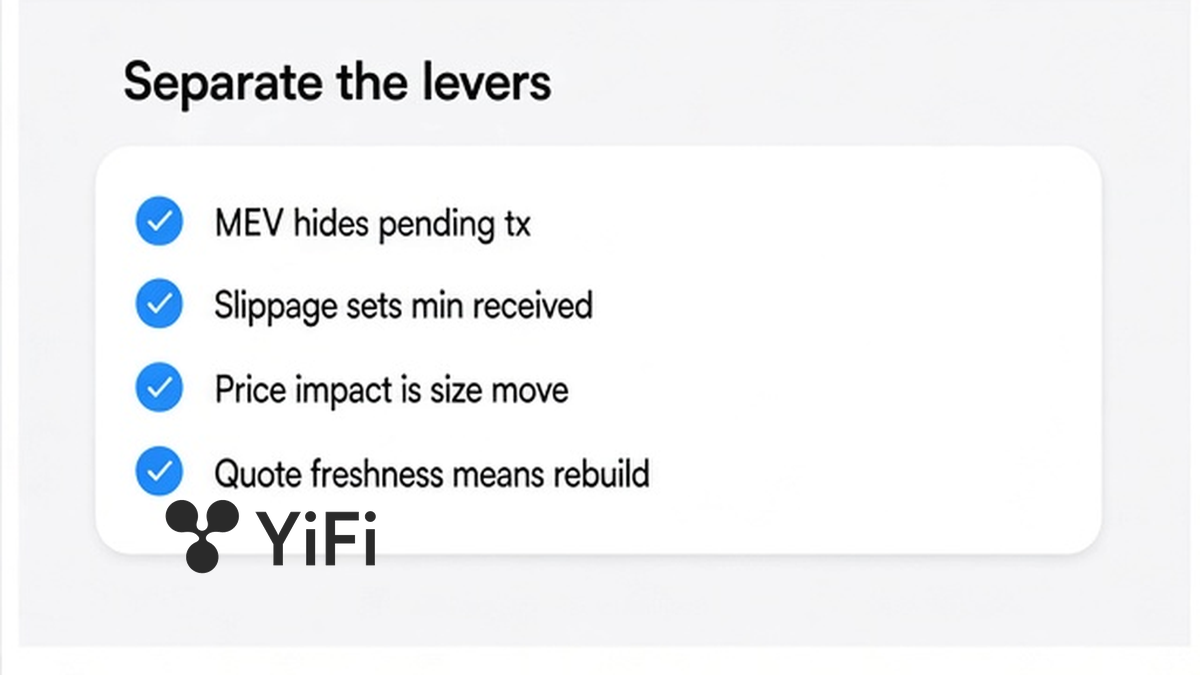
Do name the layer in plain words before mixing it with slippage. People say “private” for three different jobs; mixing labels turns on the wrong tool and still signs a bad min received.
| Layer | What it does | When to pick it | What it is not |
|---|---|---|---|
| Public path | Pending swap can sit in the open mempool | Small, liquid, simple hops | Not “unsafe forever” – risk scales with size |
| Private / MEV submission | Private RPC or protected DEX/builder path hides the pending tx | Value-moving DEX swaps on mempool chains | Not a best-price or censorship-proof promise |
| Veiled Smart Routing | Aggregator can hide the path on large trades | Large aggregator trades (YiFi homepage FAQ) | Not anonymity; quotes stay indicative |
| Private / Stealth rail | Two-leg partner hop for reduced linkability | When linkability is the goal and partner terms are OK | Not a Flashbots-style private mempool |
Ethereum examples: Flashbots Protect documents https://rpc.flashbots.net/fast and warns not to switch RPCs before confirmation – that can resend the trade publicly. MEV Blocker documents https://rpc.mevblocker.io plus modes such as /fast, /noreverts, and /fullprivacy. A private RPC reduces mempool frontrun exposure; it does not guarantee fair ordering or best execution.
Keep protection and slippage as two levers. MEV tools hide how the pending trade is seen; slippage and min received define the worst fill you still accept. Price impact is how much your size moves the pool; quote freshness is whether the card still matches the market. MEV Blocker’s FAQ: always set slippage; no solution is 100%. Flashbots Protect hides txs from the public mempool and avoids including reverted txs – still not a substitute for min received. YiFi Swap Terms treat quotes as indicative. See how to set slippage tolerance before signing and how to check price impact before a swap.
Do: Enable MEV tools and keep a sane min received on a fresh quote. Don’t: Treat “protected” as permission to ignore slippage, or call Private/Stealth “MEV protection.”
When to prefer a private or veiled route vs the public path for small liquid pairs
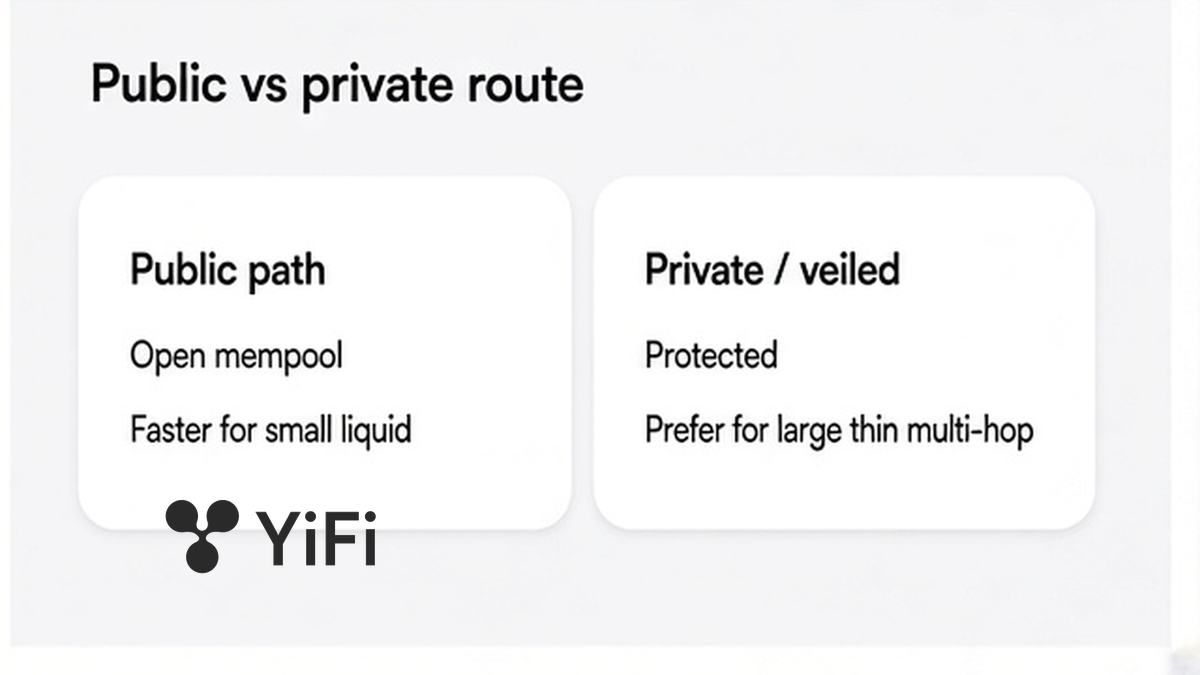
Do prefer a private, veiled, or protected path when size is large vs depth, liquidity is thin, the path is multi-hop on a public AMM, or you do not want the pending swap gossiped. Uniswap’s tips: private mempools or intents, tight slippage, and deep pools. Prefer the public path for small liquid blue-chip hops, when you need speed, or when the chain already limits third-party sandwiches. Leave public when sandwich payoff looks low; move to private submission or a veiled route when the pending swap is worth attacking. Rail picking: DEX vs CEX swap route checklist.
Do: Prefer private or veiled when size, thin liquidity, or multi-hop gossip risk is real. Don’t: Force a private path on every tiny liquid L2 swap just in case.
How to use Smart Routing on an aggregator without treating privacy as best fill
On YiFi Swap, read the route card. Smart Routing compares DEX, CEX, and other liquidity; the homepage FAQ states that for large trades it can veil the route and use chain mechanisms against front-runners – FAQ language, not a percent guarantee. Providers docs note on-chain MEV protection can be available (for example via CoW Swap). Do not treat privacy as best-fill insurance. Choose Private or Stealth only when reduced linkability is the goal: docs describe Private (XMR-hop) vs Stealth (stable-hop) as two off-chain partner legs (up to about 15 minutes, average around 3) – not anonymity. Partners may KYC, freeze, or delay; YiFi itself does not KYC Swap users. A veil is not Private/Stealth, and neither replaces min received.
Do: Use Smart Routing veil or on-chain MEV tools when sandwich risk warrants it, and still re-read min received. Don’t: Force Private/Stealth for MEV when you only needed a private RPC or veiled route, or treat privacy as best fill.
Pre-sign checklist: enable protection only with a named reason, then re-check min received
Run this pass on every fresh quote before you sign or send. Rebuild if the card sat open; confirm only when every box fits.
- Score size vs depth, hops, pair volatility, and public-mempool gossip risk.
- Name the layer in one sentence: public path, private/MEV submission, veiled Smart Routing, or Private/Stealth rail.
- Enable protection only with that named reason – or leave public and write why.
- Re-check min received, destination asset, chain, and receiving wallet together.
- If an off-chain hop shows a KYC label, read it and accept partner rules, or switch rails.
- If you use a wallet private RPC on Ethereum, select it before the swap and do not switch RPC while pending.
- After submit, wait on the same protected path; do not resubmit publicly to speed up.
Workflow: Score risk → Name layer → Set protection on/off with a reason → Refresh quote → Re-check min received + destination → Sign → Wait on the same path
When the checklist is green, open YiFi Swap again, run the same pass on a new quote, and sign only then. For sandwich concepts, see MEV sandwich protection for large swaps; use this article for the on/off decision.
Do: Leave a one-line reason (“thin pair, mainnet, private RPC on”). Don’t: Rebroadcast a protected swap onto a public RPC.
Frequently asked questions
Does MEV protection guarantee the best price?
Treat protection as reduced sandwich exposure, not a best-fill promise. Re-check min received on a fresh quote and keep slippage sane; private submission is not a 100% or best-execution guarantee.
When is a standard public RPC enough?
Keep the public path when size is small vs a deep liquid pool, the hop is simple, and the chain already limits third-party sandwiches. Still refresh the quote and confirm destination; public is not a free pass to skip min received.
How does Smart Routing veiling differ from a private RPC and from YiFi Private/Stealth?
Name the layer before you toggle anything. A private RPC hides the pending tx from the public mempool; Smart Routing veiling can hide the route on large aggregator trades per the homepage FAQ; Private/Stealth is a two-leg partner rail for reduced linkability, not a mempool shield.
Should I always enable MEV protection on every swap?
Score first, then decide. Leave protection off when sandwich payoff looks low; turn it on for large, thin, or multi-hop trades on gossip-mempool chains – always with a one-line reason.
Can I switch my wallet RPC while a protected swap is pending?
Leave the same protected endpoint selected until confirmation. Flashbots Protect warns that switching RPCs before confirm can resend the tx to the public mempool.
Is a Private or Stealth rail the same as MEV protection?
Use Private/Stealth only when reduced linkability is the goal and you accept partner timing and terms. For sandwich risk on an on-chain DEX hop, prefer private/MEV submission or a veiled route instead of treating the privacy rail as a mempool shield.