How to Choose DEX vs CEX Routes on a Swap Aggregator

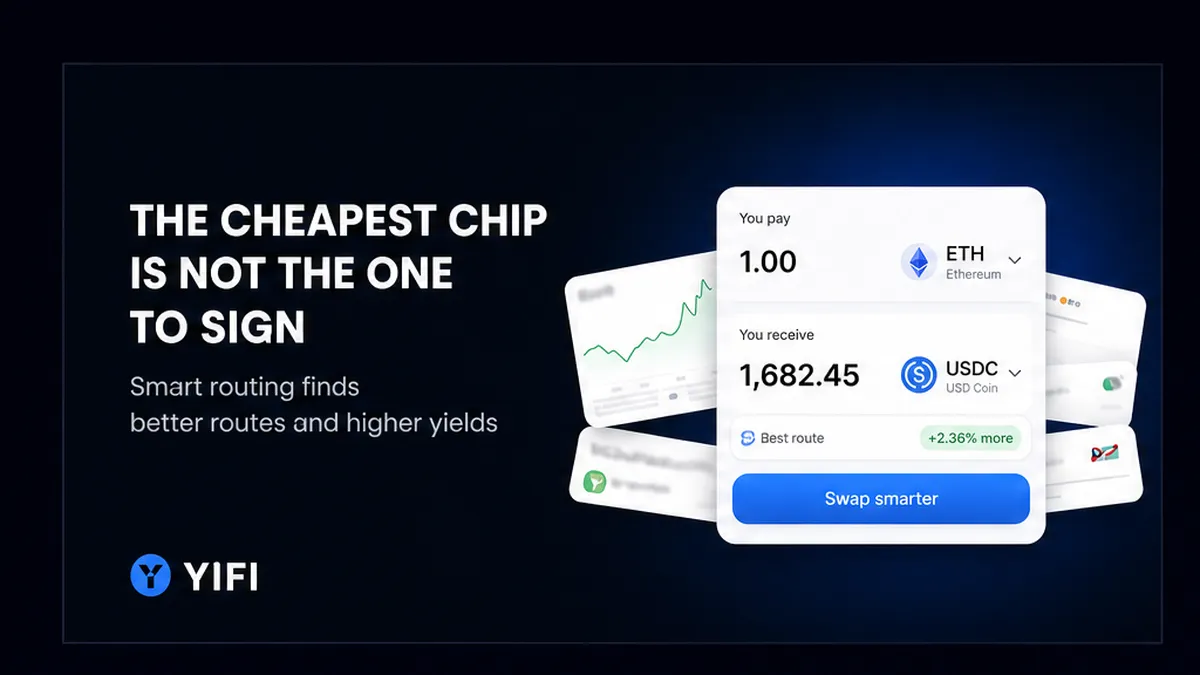
A swap aggregator can put three route types on one quote card. DEX goes through on-chain pools. CEX goes through an off-chain desk. Private or veiled liquidity tries to keep the trade off the public mempool. The cheapest-looking chip is not the one to sign. Open official YiFi Swap, read the route type, and use a DEX-only or CEX-only filter if you need it. Sign only a fresh quote you can explain in one sentence.
Summary: Treat DEX, CEX, and private liquidity as three legs on one Smart Routing screen, not three separate products. Start DEX-only when you want an explorer trail and no desk in the middle. Take a CEX hop only after you read the KYC label and accept that provider’s hold rules. Use private or veiled routes when size or a thin pool makes a mempool sandwich likely, then sign only a fresh quote.
YiFi is a non-custodial swap aggregator: you keep the keys. The homepage describes Swap as a full-spectrum aggregator across DEX, CEX, and private liquidity through Smart Routing. Smart Routing is the ranker that compares sources and proposes one path. Quotes are estimates, not locked. This is not financial advice. Quote fields (output, gas vs LP fee, minimum received) are in the live guide on how to read a crypto swap quote.
How to read unified liquidity on one quote screen
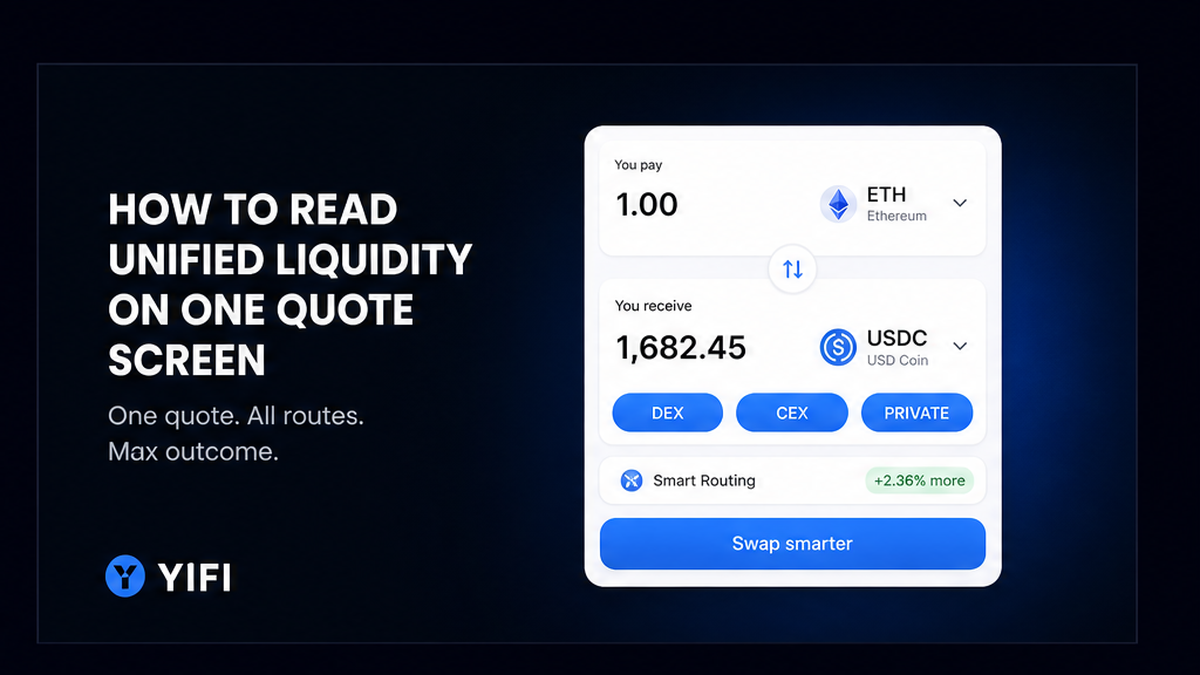
A DEX is a decentralized exchange: a pool of coins in a smart contract. You swap with the pool, not a company desk. A CEX is a centralized exchange: a company processes the trade. On an aggregator, a CEX route means an off-chain provider handles the hop. YiFi does not become that exchange. Private liquidity here is not private-equity jargon. It is often an RFQ, a request for quote to market makers, or a veiled route. That is quieter than shouting the trade into the public mempool.
YiFi homepage FAQ text says Smart Routing compares DEXs, CEXs, and other liquidity, then looks for one path. You can filter to DEX-only or CEX-only. Named homepage sources include LI.FI, Rango Exchange, 0x, Quickex, and ChangeNOW. LI.FI’s docs describe an on-chain stack of bridges and DEX aggregators, not a CEX order book. Open only the official YiFi Swap screen. Set the pair, size, and chains you will actually execute. If you cannot explain the hop, do not sign.
Compare DEX, CEX, and private routes before you sign
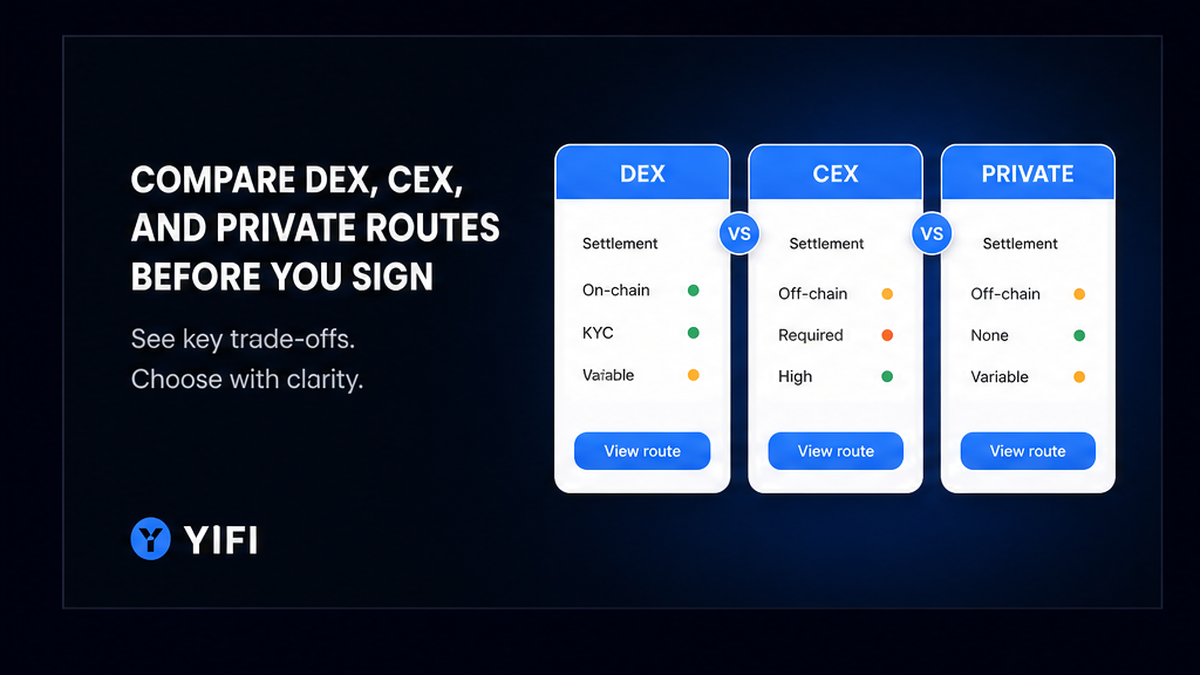
Use the table as a pre-sign filter, not a best-price promise. A KYC label is a small UI hint that an off-chain provider may ask for identity checks. Swap Terms (updated 17 July 2026) call quotes, rankings, and KYC labels informational. They can be stale. The provider’s rules win.
| What to check | DEX / on-chain | CEX / off-chain | Private / RFQ / veiled |
|---|---|---|---|
| Settlement | On-chain pools. Public explorer trail. | Off-chain exchanger. Own terms. | Private channel or veiled path. Not a mixer. |
| Who can hold funds mid-route | YiFi does not take custody. | Provider may briefly hold funds. | RFQ to makers. Or a desk if that is the fill. |
| KYC / freeze | No YiFi KYC. Terms still apply. | Provider may KYC, delay, freeze, or reject. | If hop is off-chain, re-read the KYC label. |
| Depth vs size | Good for liquid same-chain pairs. | Can be deeper on large majors. | When a public pool cannot absorb size. |
| MEV / path visibility | Public mempool can sandwich the trade. | Desk flow. Hold risk replaces mempool risk. | Homepage FAQ: large trades can veil the route. |
Route pick: Small same-chain pair with gas and an explorer trail → DEX-only. Large major or cross-chain where the desk is deeper, and you accept KYC/hold rules → CEX hop. Thin pool or sandwich risk → private or veiled; if that hop is still off-chain, read the KYC label again.
Do compare routes on estimated output after gas, not the prettier ticker. Do not sign a path you cannot map to one row. Freeze risk on large sends is covered in non-custodial vs custodial swaps for large amounts.
When a DEX-only filter is the safer default
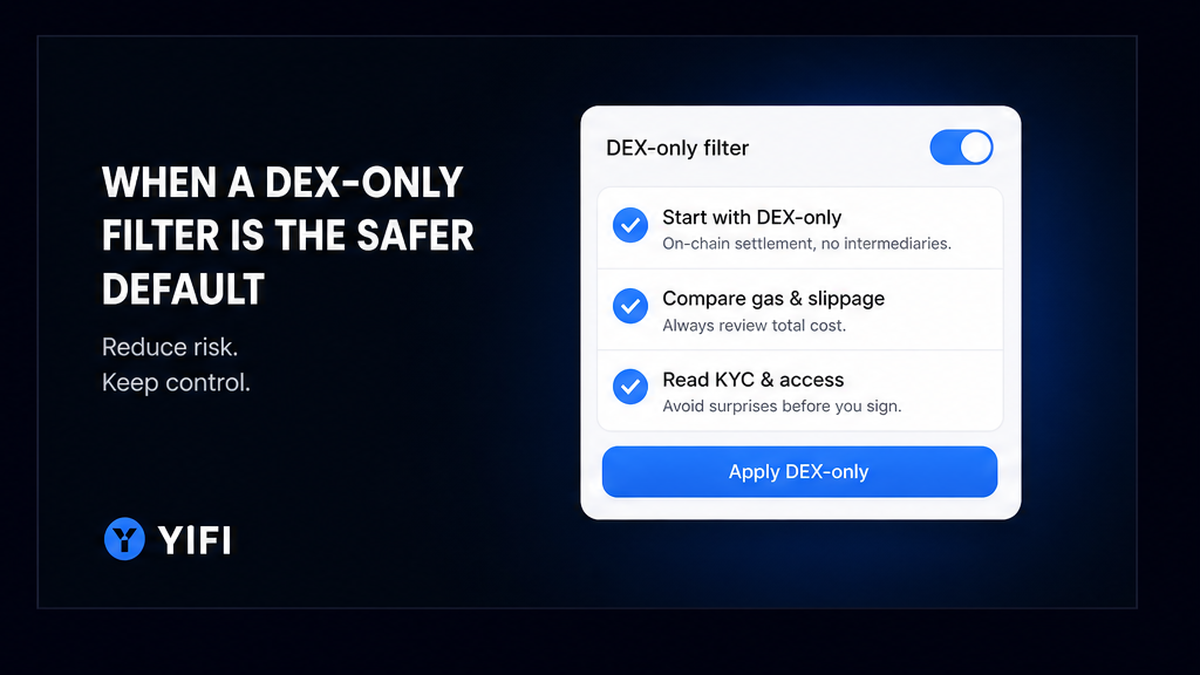
Turn on DEX-only when the pair is liquid on-chain. You still need source-chain gas and a public explorer trail. Homepage FAQ text says you can filter routing to DEX-only or CEX-only. After you flip the filter, compare estimated output plus gas with the unfiltered quote. If DEX-only is empty or the floor looks ugly, inspect a CEX hop. Do not raise slippage as the first move.
- Do start DEX-only on small, deep, same-chain swaps when you have native gas.
- Do re-read estimated output and minimum received after the filter.
- Do not sign an unfiltered path if you already rejected the desk risk.
- Do not treat DEX-only as a promise of the lowest fee on every pair.
Avoid treating “on-chain” as zero risk. Pools still have price impact. DEX-only only removes the off-chain desk. If you cannot explain the remaining hops, stop.
When CEX depth is worth the KYC and hold risk
Use a CEX hop when DEX-only is thin or missing. Take it only if the extra estimated output is worth the counterparty. Swap Terms §6.3 say your relationship is with that provider, who may KYC, delay, freeze, reject, or reverse. YiFi’s AML policy (updated 16 July 2026) says YiFi itself does not run KYC or AML on Swap users; third parties can. This guide does not list restricted countries. Open the Swap Terms if a label is unclear, then pick another route or DEX-only.
Named homepage provider ChangeNOW states in its AML/KYC terms (updated 17 July 2026) that checks can be risk-based. An unusual transaction can be placed on hold. Industry CEX hops can briefly touch a partner exchange; YiFi still does not become the custodian. Do read the KYC label before you allow CEX-only. Do not send a second swap if the first sits on verification.
Check size, slippage, and MEV: when to use a private route
MEV is bot activity around your trade. Your swap sits in the public mempool. A bot can sandwich it: buy just before you, sell just after, so you get a worse fill. Slippage is how far below the estimate you still accept. Private liquidity tries to take the shout out of that waiting room. 0x/Matcha (October 2023) describe RFQ as a private channel to market makers instead of a public AMM mempool. YiFi homepage FAQ text says that for large trades, routing can veil the route against front-running. Treat that as MEV hygiene, not anonymity. Do not switch on private on a tiny, deep swap. If the trade would move a thin pool, look at private or veiled. Or split size using the guide on swapping large crypto without moving the market. Do not raise slippage so the swap “just goes through” before you refresh or change route type. Veiling a path that is still an off-chain desk does not cancel that desk’s KYC rules.
Run this decision checklist on the next swap
If any line fails, do not sign. Refresh means request a new quote, not a stale payload.
Workflow:
Official Swap UI → pair / size / chains → read route type → DEX-only or CEX-only filter if needed → KYC label + min received + destination → refresh → sign.
- Open only the official YiFi Swap UI and set the pair, size, and chains you will actually execute.
- Read the route type: DEX / on-chain, CEX / off-chain, or private / veiled. If you cannot explain the hop, stop.
- If you want keys-only and no desk, turn on DEX-only and compare estimated output plus gas with the unfiltered quote.
- If DEX-only is thin or missing, inspect the CEX hop and read the KYC label before you accept a possible hold.
- If size would move a thin pool, check private or veiled. Skip it on a small deep swap if it adds an off-chain hop you did not want.
- Confirm estimated output, gas vs LP or exchange fee, minimum received, and destination ticker, chain, and wallet. Refresh if stale.
- Sign only the fresh payload. A CEX verification hold is that provider’s process, not a YiFi freeze.
Avoid signing because the headline rate “looks fair,” a CEX hop if you already refused KYC, or private mode on dust-size liquid pairs. Homepage FAQ text says YiFi charges no additional platform fee on swaps; you still pay gas and exchange or LP fees. Swap Terms §10 say any YiFi fee is shown before you confirm. Next: run the seven steps, then open YiFi Swap and sign only a fresh payload.
Frequently asked questions
Can I force DEX-only on a swap aggregator?
Yes. Homepage FAQ text says you can filter routing to DEX-only or CEX-only. Do it before you sign if you do not want an off-chain desk.
Is CEX liquidity on an aggregator custodial?
YiFi does not take custody. An off-chain provider in the hop may hold funds under its own terms and may delay or freeze. Read the KYC label; pick DEX-only if that risk is unacceptable.
Does Smart Routing hide the path?
Homepage FAQ text says that for large trades the router can veil the route to reduce front-running. That is MEV hygiene, not a mixer, and it does not erase on-chain history.
When is a CEX route worth it?
When the filtered DEX quote is thin or missing and you accept that provider’s KYC and hold rules. Compare estimated output after gas, not the prettier ticker.
When should I use private liquidity?
When size or a thin pool makes a public mempool sandwich likely. Skip it on small, deep swaps if it adds an off-chain hop you did not want.
Why did the CEX quote look better, then ask for ID?
Quotes are indicative. Off-chain desks run their own checks; ChangeNOW may place an unusual transaction on hold. Do not send a second swap; follow that provider’s flow or restart on DEX-only.
Does YiFi add a platform fee if I pick CEX vs DEX?
Homepage FAQ text says there is no extra YiFi platform fee on swaps. You still pay gas and exchange or LP fees. Any YiFi fee would be shown before confirm (Swap Terms §10).