Kaspa (KAS): Fast Proof-of-Work, BlockDAG and the Path to Programmability

Kaspa is a Proof-of-Work network that uses a blockDAG instead of a linear blockchain.
Parallel blocks are kept and ordered rather than discarded, which allows high block rates while preserving PoW security. Mainnet currently runs at 10 blocks per second after the Crescendo upgrade.
The Toccata hard fork (June 2026) added native L1 programmability through covenants and ZK verification. KAS is the native asset, fair-launched with no premine or ICO.
The next major consensus step on the roadmap is DAGKnight.
What Is Kaspa?
Kaspa is a decentralized, open-source Proof-of-Work Layer-1.
Its core design choice is architectural: instead of a single chain of blocks, Kaspa maintains a blockDAG (directed acyclic graph of blocks).
In a traditional longest-chain design, competing blocks may become stale and stop contributing to the canonical history.
GHOSTDAG, Kaspa’s consensus protocol, instead incorporates parallel blocks into the DAG and orders them, allowing the network to tolerate a much higher rate of concurrent block production than a conventional linear-chain design.
This architecture is what allows Kaspa to operate at higher block rates while retaining Proof-of-Work consensus and continuing to rely on miners rather than a staking-based validator set.
As of the Crescendo hard fork, mainnet targets 10 blocks per second (roughly one block every 100 ms).
Kaspa positions itself around “real-time decentralization”: fast inclusion and confirmation characteristics while remaining pure Proof-of-Work.
Where Did Kaspa’s Consensus Design Come From?
Kaspa’s technical lineage comes from academic work on scalable PoW consensus:
- Early research on GHOST
- SPECTRE
- PHANTOM / GHOSTDAG
Key research figures associated with this line of work include Yonatan Sompolinsky (with connections to the Hebrew University of Jerusalem and later Harvard) and collaborators who developed the theoretical foundations that Kaspa implements in production.
Fair launch is a central part of Kaspa’s identity.
Mainnet launched in November 2021 with:
- No ICO
- No premine
- No presale
- No insider or team allocation
KAS entered circulation through mining rather than through a premine, ICO or team allocation.
That distribution model remains one of the project’s most frequently cited distinguishing features.
How Did Crescendo Move Kaspa to 10 BPS?
Kaspa did not start at 10 blocks per second.
The network originally targeted 1 BPS.
Scaling required both software and consensus work.
The node implementation moved from the earlier Go client toward Rusty Kaspa (Rust), which improved performance and prepared the network for higher throughput.
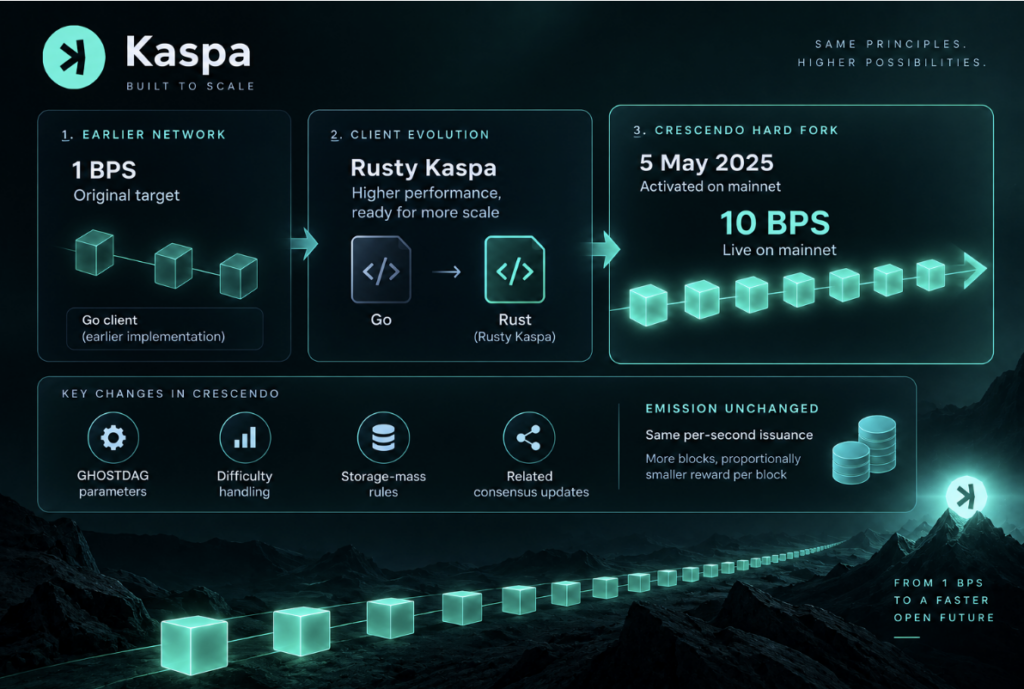
The Crescendo hard fork then activated on mainnet on 5 May 2025, raising the block rate from 1 BPS to 10 BPS.
Important accompanying changes included adjustments to GHOSTDAG parameters, difficulty handling, storage-mass rules and related consensus details so that security properties scaled with the higher block rate.
Emission was kept consistent on a per-second basis: more blocks per second, proportionally smaller reward per block.
Crescendo is the milestone that turned “Kaspa is fast” from a design claim into a live mainnet operating point.
What Did the Toccata Upgrade Add?
Speed alone does not make an application platform.
Toccata, activated on mainnet on 30 June 2026, is the upgrade that began adding meaningful L1 programmability.
In practical terms, Toccata introduced:
- Covenants — spending rules that can constrain how outputs are created and that can carry state forward across transactions
- Richer transaction introspection — scripts can examine more of the spending transaction
- Native ZK verification opcodes — allowing certain zero-knowledge proofs to be checked directly in script
- Supporting infrastructure for “based” applications and sequencing commitments
Silverscript provides higher-level tooling so developers can write covenant logic without working only in raw opcodes.
What this changes: Kaspa is no longer limited to simple value transfers of KAS.
Developers can begin building more expressive UTXO-based applications — for example programmable vaults, constrained spending conditions, asset issuance and transfer logic, and foundations for more advanced systems.
What is still developing: fuller shared-state models and the longer-term vProgs (verifiable programs) path remain roadmap work rather than a finished, general-purpose smart-contract environment equivalent to mature EVM ecosystems.
Toccata is live; the broader application stack is still early.
What Is Being Built on Kaspa?
Live mainnet products should be distinguished from testnet or in-progress work.
The Kaspa ecosystem has historically been strongest around:
- Mining and node infrastructure
- Wallets and basic payment tooling
- Explorers and indexing
After Crescendo and especially after Toccata, activity has broadened toward:
- Token / asset-issuance experiments
- Bridges and cross-chain access paths
- Early DeFi and swap interfaces
- Developer tooling around covenants and ZK verification
- L2 and “based app” efforts that sit on top of Kaspa’s sequencing and proof capabilities
The ecosystem is also beginning to take shape through concrete initiatives such as KRC-20, which introduced fungible token activity around Kaspa, as well as projects exploring smart-contract and Layer-2 infrastructure such as Kasplex zkEVM. Together with emerging wallets, bridges, swap interfaces, and developer tooling, these projects show how the ecosystem is gradually expanding beyond KAS transfers and mining infrastructure.
Because many parts of Kaspa’s application ecosystem are still developing, the status of individual projects should be distinguished carefully between live mainnet products, testnet deployments, and ongoing development.
The direction of travel is clear — from a high-speed PoW payment network toward a broader application and settlement layer — but the application layer is still in an early growth phase.
What Is KAS?
KAS is the native asset of the Kaspa network.
It is used for:
- Transaction fees
- Mining rewards
- Economic security of the PoW system
Supply and emission
- Approximate maximum supply: ~28.7 billion KAS
- Fair launch: no premine, no ICO, no allocations
- Emission follows a chromatic schedule: rewards decline smoothly each month by a factor of (1/2)1/12, designed to produce roughly a yearly halving
Because emission is defined on a per-second basis, the move to 10 BPS did not accelerate total issuance; it split the same subsidy across more blocks.
KAS Market Overview
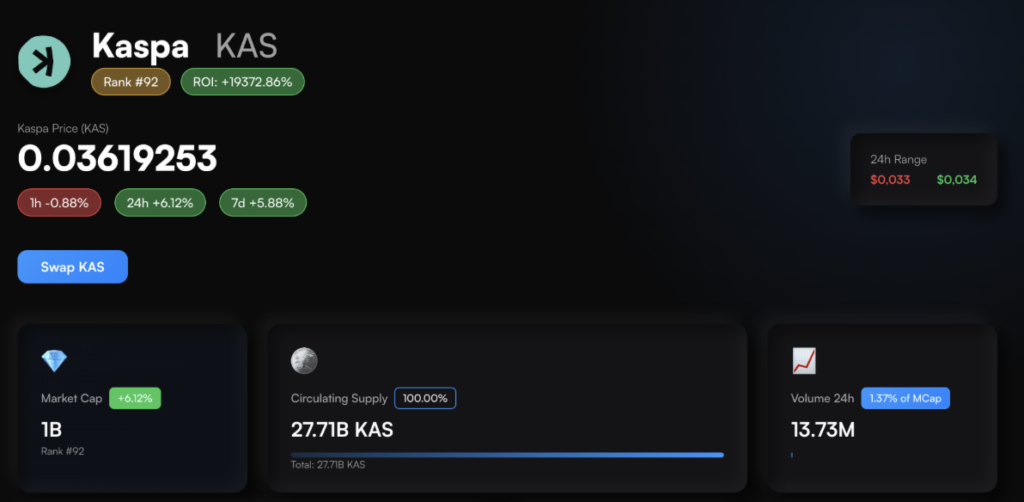
As of September 18, 2026, KAS is trading at approximately $0.0354, with a market capitalization of around $982 million and approximately 27.71 billion KAS in circulation. Its 24-hour trading volume is around $11.7 million, placing KAS at #61 among cryptocurrencies by market capitalization.
Beyond short-term price movements, recent developments around KAS have been closely tied to major network milestones, including the move to 10 BPS with Crescendo, the activation of Toccata and L1 programmability, and continued development toward DAGKnight. These upgrades mark Kaspa’s broader evolution from a high-speed PoW network toward a more programmable ecosystem.
Market figures should be updated on the day of publication.
What Comes Next: DAGKnight and Beyond?
The next major consensus-oriented step on the official trajectory is DAGKnight.
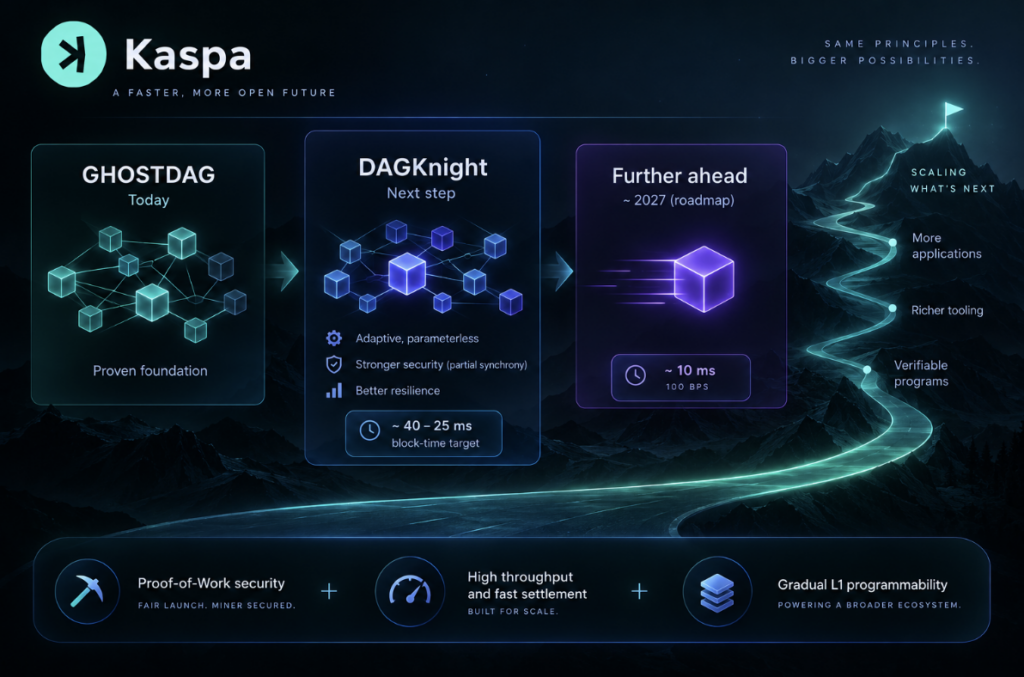
Today’s GHOSTDAG relies on protocol parameters tied to assumed network latency bounds.
DAGKnight is designed as a more adaptive, parameterless successor: confirmation behaviour aims to track actual network conditions more closely, with research emphasis on strong security properties under partial synchrony and improved resilience characteristics.
Official lore frames DAGKnight block-time targets in the roughly 40–25 ms range.
Official materials also discuss a later hard-fork direction around 2027 that explores movement toward the order of 10 ms / 100 BPS.
These are roadmap targets, not live mainnet parameters.
In parallel, the ecosystem continues work on verifiable programs, tooling and application primitives that build on Toccata’s foundations.
Taken together, Kaspa’s stated direction is to combine:
- Proof-of-Work security
- High throughput and fast settlement characteristics
- Gradual L1 programmability
without abandoning the fair-launch, miner-secured base layer.
How Can Users Access KAS Through YiFi?
KAS is already available for swaps through YiFi, giving users access to multiple exchange routes through a single non-custodial platform. YiFi aggregates routes from multiple connected providers, allowing users to compare available options for KAS and choose the most suitable route.
Depending on the selected pair and current provider support, different execution options may be available, including off-chain, on-chain, and private swaps. As YiFi continues to expand its provider infrastructure, the number of available routes and supported assets will continue to grow.
Users can review the available routes, rates, network details, and expected receive amount directly through YiFi before making a swap.
Exchange Bitcoin for Kaspa in a couple of clicks.
Frequently Asked Questions
Is Kaspa a blockchain?
Kaspa uses a blockDAG rather than a single linear chain.
Blocks can be created in parallel and are ordered by the consensus protocol instead of being discarded as orphans.
How fast is Kaspa today?
Mainnet targets 10 blocks per second following the Crescendo upgrade in May 2025.
Inclusion is fast; deeper confirmation confidence remains probabilistic, as with other PoW systems.
Was there a premine or ICO?
No. Kaspa launched in November 2021 with no premine, ICO, presale or insider allocation.
KAS entered circulation through mining.
What did Toccata add?
Native L1 programmability features, including covenants, expanded transaction introspection and ZK verification support.
It activated on mainnet on 30 June 2026.
Does Kaspa have smart contracts?
Kaspa now supports native L1 programmability through covenants and ZK verification, but its broader application stack is still early.
Toccata is live, while shared-state systems such as vProgs remain under development.
Is DAGKnight live?
No.
DAGKnight is a planned consensus upgrade on the roadmap, not current mainnet consensus.
What is KAS used for?
Network fees, mining rewards and as the native economic asset of the Kaspa PoW system.
Closing View
Kaspa is one of the clearer live experiments in scaling Proof-of-Work through topology rather than through a shift to staking.
GHOSTDAG and the blockDAG let the network keep parallel work; Crescendo turned that design into a 10 BPS mainnet; Toccata opened the door to programmable UTXOs and ZK verification on L1.
The project still has to prove how quickly a durable application ecosystem forms around those capabilities, and roadmap items such as DAGKnight remain ahead.
For users and builders, the current picture is concrete: a fair-launched PoW network with unusually high block frequency, an emission schedule without insider allocations, and a newly activated programmability layer that is only beginning to be used.
Primary sources
- Kaspa official site — network positioning and fair-launch materials
- Kaspa Lore — Toccata, DAGKnight and roadmap framing
- Crescendo / Rusty Kaspa release materials — 10 BPS activation (5 May 2025)
- Toccata release and KIP materials — covenants, ZK verification, sequencing (30 June 2026)
- Kaspa tokenomics / emission documentation — ~28.7B approximate maximum supply and chromatic schedule
Disclaimer
This article is for informational purposes only and does not constitute financial, investment or technical advice.
Cryptocurrency networks, fees, routes and software change. Always verify current network parameters, wallet compatibility and swap quotes before transacting.