Horizen (ZEN): Privacy-First Layer 3 on Base

Horizen (ZEN) is an EVM-native Layer 3 on Base focused on private and compliance-aware onchain applications. ZEN migrated to Base as an ERC-20 on 23 July 2025 and has a fixed maximum supply of 21 million. Staking is live on Horizen, while Vela confidential compute is currently available on local and testnet environments.
What Is Horizen?
Horizen is an EVM-compatible Layer 3 built on Base using the OP Stack, designed for private onchain finance and compliance-aware blockchain applications. Horizen’s official architecture documentation describes Horizen as an EVM-compatible L3 that settles on Base.
Horizen uses Base as its settlement layer and keeps standard EVM development workflows, so developers can build with Solidity and familiar Ethereum tooling.
Horizen adds privacy and compliance capabilities at the application layer rather than requiring developers to use a separate programming environment. Developers can choose confidential execution and related privacy features for a specific application, or deploy standard transparent contracts when privacy is not required.
This architecture connects Horizen applications with the wider Base and Ethereum ecosystem while providing a dedicated environment for privacy-focused use cases. Horizen is designed for private DeFi, payments, business applications, and other onchain products where transaction data or application logic may require additional confidentiality or controlled disclosure.
The OP Stack also gives Horizen a familiar technical model for developers already working with Ethereum and Base. The result is an EVM-compatible environment where privacy features can be introduced without replacing standard smart-contract development practices.
Horizen therefore combines Base settlement, EVM compatibility, and application-level privacy tooling in a Layer 3 architecture focused on private onchain finance.
How Did Horizen Evolve From ZenCash to an L3 on Base?
Horizen began in May 2017 as ZenCash, a privacy-oriented blockchain that later became Horizen and expanded into a multi-chain ecosystem. The project developed sidechain infrastructure and the EON EVM network before changing its architecture again in 2025. This transition moved ZEN and the network toward an Ethereum-aligned model built around Base.
The key transition happened on 23 July 2025, when ZEN migrated to Base as an ERC-20 token.
Horizen’s official migration documentation states that the old mainchain and EON were being discontinued and that ZEN transfers were moved to the Base ERC-20 contract. The migration changed ZEN from the native asset of a standalone legacy chain into an ERC-20 asset connected to the Ethereum ecosystem.
Horizen then moved toward an EVM-native Layer 3 architecture on Base. Horizen’s roadmap describes the migration to Base, EON and ZEND deprecation, and the launch of the Horizen L3 as connected milestones. The new model focuses Horizen’s own infrastructure on privacy-enabled execution and application development.
How Does Horizen Approach Privacy?
Horizen approaches privacy as an application-layer capability that can be added when an application needs confidential execution, selective disclosure, or compliance-aware controls. Developers can continue using EVM-compatible tooling while choosing privacy features for individual use cases. This lets applications use privacy where it is needed without making every transaction or application confidential by default.
Vela is a core part of Horizen’s current confidential-compute infrastructure. Horizen’s Vela documentation describes Vela as a confidential computation layer for Horizen applications.
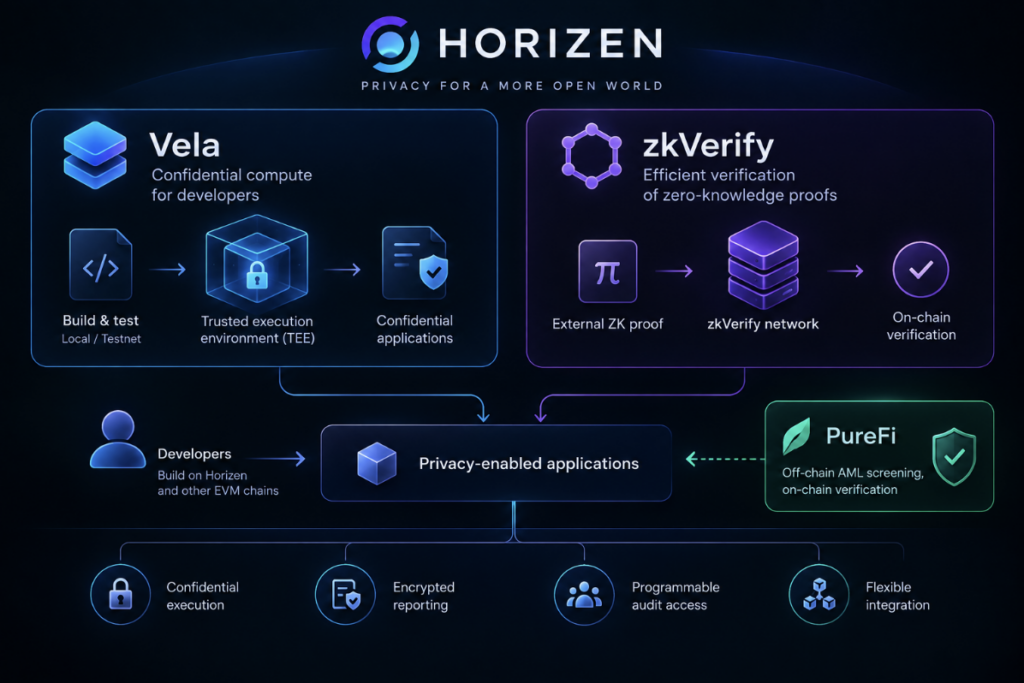
As of September 2026, builders can run Vela locally and use live testnet environments including Base Sepolia and Horizen testnet, while Base mainnet is listed as the next major milestone.
- zkVerify is a separate zero-knowledge verification network within the broader Horizen ecosystem. Applications can use zkVerify when they need efficient verification of externally generated zero-knowledge proofs.
- Horizen also documents compliance-oriented patterns such as encrypted reporting and programmable audit access. In an integration pattern with PureFi, AML screening can take place off-chain and the resulting verification can be checked on-chain before a contract action proceeds.
Developers can therefore build and test applications with confidential execution while keeping standard EVM workflows. Privacy is treated as a configurable capability rather than an all-or-nothing property of the entire blockchain.
This model allows Horizen applications to combine EVM compatibility with privacy and controlled disclosure. It is intended for use cases where confidentiality, verification, or compliance controls matter alongside composability.
Horizen’s privacy stack consequently combines confidential computation, zero-knowledge verification, and compliance-oriented integration patterns within an EVM-compatible environment.
What Is Being Built in the Horizen Ecosystem?
The Horizen ecosystem is being built around private onchain finance, privacy-enabled DeFi, and infrastructure for applications that need confidential execution or compliance-aware controls. The ecosystem includes work across private trading, lending, yield products, cross-chain privacy, and other financial applications. The common focus is making privacy part of usable onchain products rather than a separate technical layer.
As of September 2026, Horizen’s Builder Ecosystem Fund Season 2 is open and focuses on privacy-oriented applications and infrastructure. The programme includes areas such as private agentic vaults and private borrow-lend protocols, reflecting Horizen’s focus on practical applications rather than privacy as a standalone feature.
The ecosystem also includes infrastructure projects connected to Horizen’s broader privacy stack. Vela provides confidential computation, while zkVerify focuses on zero-knowledge proof verification. Other integrations can add compliance or selective-disclosure functionality around applications deployed in the ecosystem.
The objective is to make privacy usable inside familiar onchain financial workflows. Instead of requiring every application to build a separate privacy infrastructure layer, Horizen is developing a common environment where developers can combine EVM compatibility, Base settlement, privacy tooling, and compliance-oriented components.
The official Horizen roadmap places ecosystem applications, L3 development, and privacy tooling within the same broader product direction.
What Is ZEN and What Is It Used For?
ZEN is the governance and utility token of the Horizen ecosystem. ZEN has a fixed maximum supply of 21 million tokens and has no ICO or pre-mined supply according to Horizen’s official token materials. Since July 2025, ZEN has also been an ERC-20 token on Base and is used across the wider Horizen ecosystem.
On 23 July 2025, ZEN migrated to Base as an ERC-20 token. Horizen’s official ZEN token page states that eligible legacy holders can claim their migrated assets 1:1 on Base.
- The official token materials describe ZEN as supporting DeFi, staking, governance, and application utility. The token therefore has several roles in the current Horizen architecture, including ecosystem participation and staking.
- Applications can also integrate ZEN as an asset within the broader Base and Horizen environments. The move to Base changed the technical form and ecosystem access of ZEN rather than introducing a new maximum supply.
- The fixed maximum supply remains 21 million ZEN. This supply cap is stated in Horizen’s current token materials and migration documentation.
- ZEN is therefore positioned as both an ecosystem token and an asset that can move across the Base and Horizen environments.
How Does ZEN Staking Work?
ZEN staking is live on the Horizen L3 through a non-custodial, on-chain staking programme. The official staking documentation states that users interact directly with the staking contract and that there is no fixed lock-up period for staked ZEN.
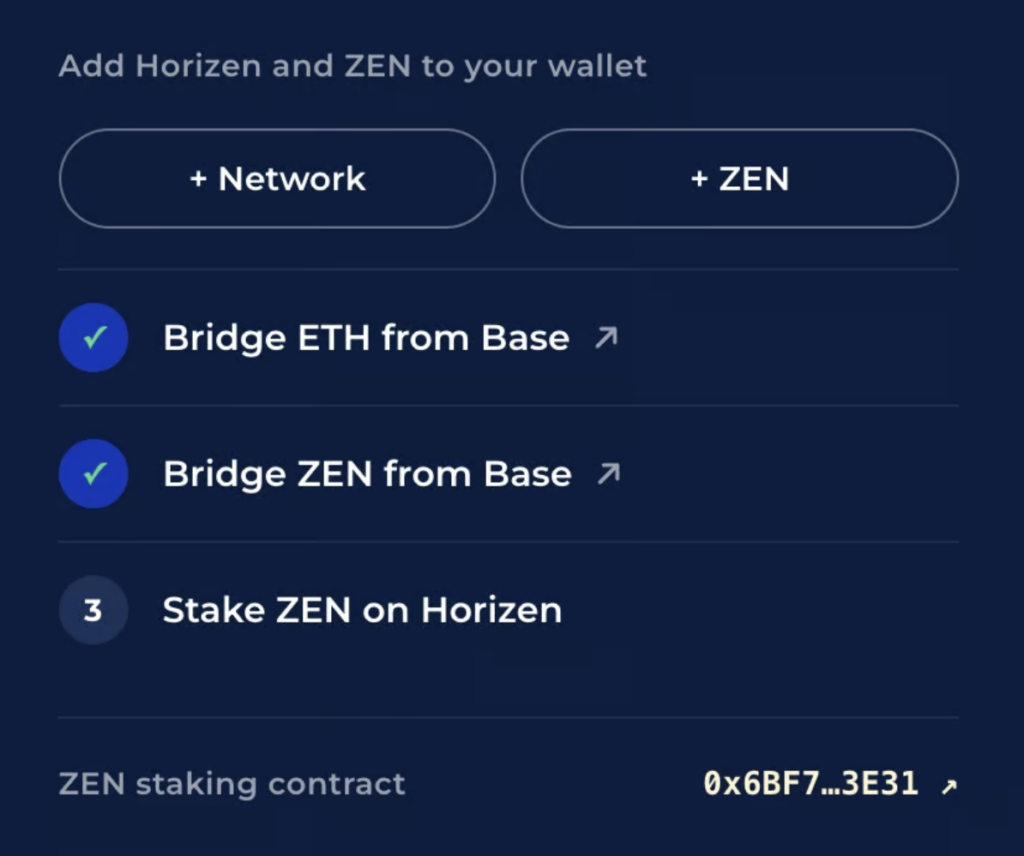
The current staking model uses a single staking pool with rewards funded from multiple sources connected to the Horizen ecosystem.
The official staking page lists sources including DAO contributions, liquidity earnings, zkVerify-related emissions, protocol and application fee sharing, and Horizen L3 sequencer fees. Vela is listed as a future source while its confidential-compute economics are still in development.
Reward rates are variable and are not guaranteed. Rewards accrue on-chain according to the current staking programme and the amount of ZEN participating in the pool.
Users can stake, claim rewards, and withdraw according to the current programme rules. The staking interface states that the principal is not subject to a fixed lock-up.
Users should check the official staking interface and current terms before staking because programme conditions, reward sources, and reward rates can change over time.
What Is Next for Horizen?
Horizen’s next development priorities include expanding the ecosystem of privacy-enabled applications and progressing confidential computation infrastructure. Vela’s official roadmap identifies Base mainnet as the next major deployment milestone after local and testnet environments.
Ecosystem development is also expected to continue through builder funding and new applications across private DeFi, lending, trading, and other onchain financial use cases. Horizen’s roadmap places the L3, application launches, and privacy tooling within the same broader transition toward an Ethereum-aligned privacy infrastructure.
The practical focus is therefore on moving from infrastructure to application usage. As more applications launch, Horizen can test how privacy, compliance controls, and standard EVM workflows work together in real onchain products.
The timing of individual launches and product milestones can change, so current Horizen documentation and roadmap materials should be used when checking the status of a specific feature.
Horizen’s near-term progress therefore depends on both infrastructure readiness and the launch of applications that use privacy features in real onchain workflows.
How Can Users Access ZEN Through YiFi?
ZEN is available for swaps through YiFi when a supported route exists for the selected pair. YiFi’s swap documentation describes its aggregator as a routing layer that compares on-chain, off-chain, and private liquidity sources.
For ZEN, the available route depends on the selected source and destination assets, provider support, liquidity, and current availability. YiFi can present different exchange options without requiring the user to search across multiple providers manually.
Users can check the available ZEN route at the time of the transaction because provider availability and supported pairs can change. This makes YiFi one access point for ZEN swaps while keeping the underlying exchange route dependent on the providers connected to the YiFi infrastructure.
The integration is separate from Horizen’s blockchain infrastructure: YiFi acts as an aggregation layer for supported swaps, while ZEN remains an asset on Base and the Horizen ecosystem.
Because YiFi routes swaps through third-party liquidity providers, the exact route, quote, fees, and settlement time can vary by asset pair and market conditions.
FAQ
Is Horizen Still a Privacy Coin?
No. Horizen is now an EVM-native Layer 3 on Base rather than the earlier standalone privacy-coin model. Its current architecture focuses on application-level privacy, confidential computation, and compliance-aware functionality within an EVM environment. The change followed the 23 July 2025 migration of ZEN to Base and the subsequent move toward the Horizen L3.
Is Horizen an L1, L2 or L3?
Horizen currently operates as an EVM-compatible Layer 3 built on Base. Horizen uses Base as its settlement layer and the OP Stack as its rollup framework. This architecture places Horizen above Base while keeping compatibility with standard Ethereum and EVM development tools.
Is ZEN Still on Its Original Blockchain?
No. ZEN migrated to Base as an ERC-20 token on 23 July 2025. Horizen’s migration documentation states that the old mainchain and EON were discontinued as ZEN transfers moved to the Base ERC-20 contract. Eligible legacy holders could claim their migrated assets on Base.
What Is Vela on Horizen?
Vela is a TEE-based confidential compute system developed for the Horizen ecosystem. As of September 2026, Vela is available for local development and testnet use, including Base Sepolia and Horizen testnet. Horizen’s official Vela roadmap lists Base mainnet as the next major deployment milestone.
Is ZEN Staking Live?
Yes. ZEN staking is live on the Horizen L3 through a non-custodial, on-chain staking programme. The official staking interface states that there is no fixed lock-up and that users can claim rewards and withdraw according to the current programme rules. Reward rates are variable and are not guaranteed.
What Is the Maximum Supply of ZEN?
The maximum supply of ZEN is 21 million tokens. Horizen’s official token materials state that the 21 million maximum supply remains unchanged after the migration to Base. The same materials also state that ZEN had no ICO or pre-mined supply at its original launch.
Can I Swap ZEN on YiFi?
Yes. ZEN can be swapped through YiFi when a supported route is available for the selected pair. YiFi aggregates connected liquidity providers and can surface on-chain, off-chain, or private swap routes depending on the pair and current provider support. Route availability and execution conditions can change, so the available options should be checked when the swap is created.
Disclaimer
This article is for informational purposes only and does not constitute financial or investment advice. Crypto assets and staking involve risk. Network features, rewards, liquidity and swap availability can change.